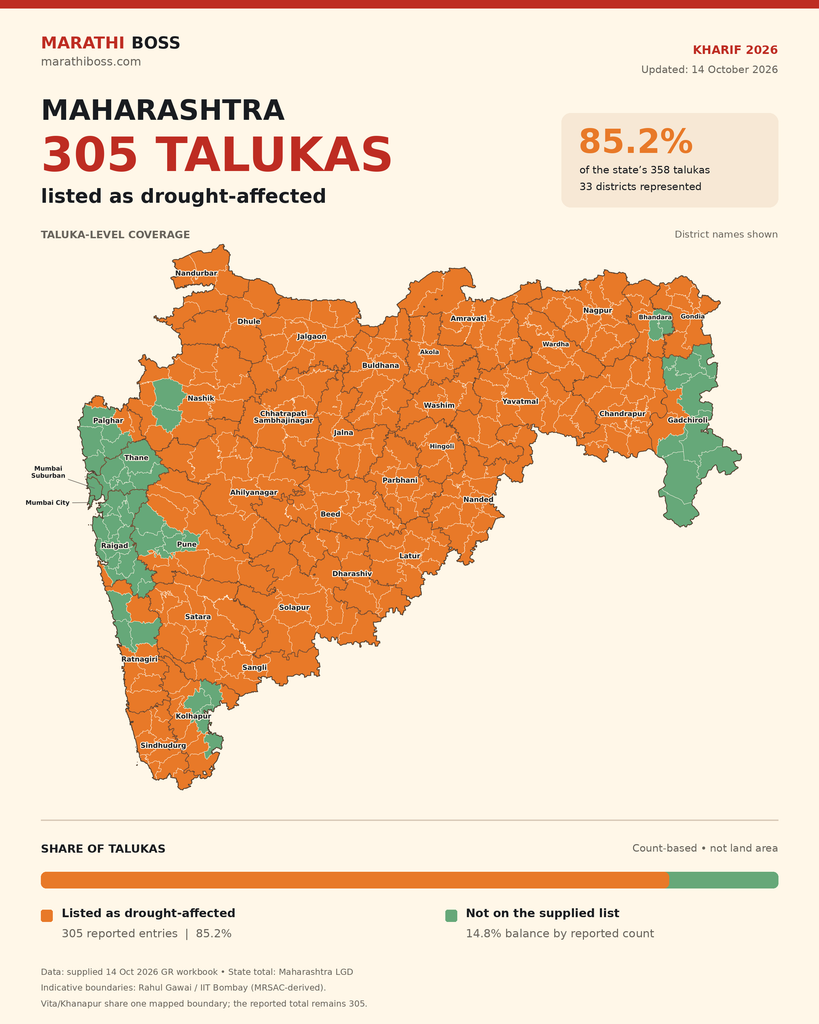
The rain has stopped. Maharashtra’s real drought test begins now.
As of October 2026, 305 talukas in Maharashtra have officially been declared drought-affected. Winter is still ahead—and so is the harsh summer of 2027. What could the coming months mean for families, villages, farms, livestock, businesses and water supplies to Mumbai, Pune and Nashik?
Drought is not merely the absence of rain. The real test is how much water saved today will still be available in February–May 2027. Urban reservoirs, village wells and farm fields all depend on the same broader water cycle.
01 / THE SITUATION Drought declared in October. What happens next?
The Government of Maharashtra has officially declared 305 talukas drought-affected, based on Trigger 1 and Trigger 2 assessments for the 2026 Kharif season. District collectors have been directed to begin crop-loss assessments, supported by photographs and GPS coordinates. Relief measures have been announced, but the specific crop-loss compensation amount is to be notified through a separate government resolution. [1]
Most of Maharashtra receives its main monsoon rainfall between June and September. Once the rains retreat, villages depend on wells, tanks and groundwater, while cities rely heavily on stored reservoir water. Meanwhile, crops, households, industry and livestock continue to need water. In some areas, higher temperatures can also increase evaporation. This makes water planning over the next six to nine months critical.
Drought-affected talukas by revenue division
Total: 305. Counts are from the appendix to the government resolution dated 14 October 2026. This chart does not measure drought severity or reservoir storage.
This timeline illustrates possible risks, not an official prediction of when any individual reservoir will run out of water.
02 / CAUSES Why does drought occur? Is El Niño the only reason?
No. A drought can develop from several interacting causes. To understand the 2026 situation, we must look separately at global climate patterns and local water-management conditions.
1. Uneven rainfall
A season’s total rainfall can look adequate even if it arrives at the wrong time. Long dry spells, intense downpours that run off quickly and poor rainfall over particular catchments can all affect crops and storage.
2. El Niño and the monsoon
Changes in Pacific Ocean temperatures can alter winds and rain-bearing systems. El Niño can increase the risk of a weaker Indian monsoon, but not every El Niño year produces drought in Maharashtra.
3. Groundwater pressure
When groundwater withdrawal exceeds natural recharge, well levels decline. Hard-rock geology, excessive pumping and reduced infiltration can make shortages worse. [8]
4. Land use and rising demand
Expanding cities, paved surfaces, leaking pipelines, growing household and industrial demand, and water-intensive crops poorly matched to local conditions all add pressure to limited water supplies.
What about climate change? Rising temperatures and more extreme heat can increase evaporation and water demand. But it would be scientifically unjustified to conclude, without a dedicated attribution study, that Maharashtra’s entire 2026 drought was caused only by climate change—or only by El Niño.
03 / EXPLAINER What exactly is El Niño? Is “Super El Niño” a real category?
El Niño refers to unusually warm surface waters across the central and eastern equatorial Pacific Ocean, together with changes in atmospheric circulation and rainfall. It is the warm phase of ENSO—the El Niño–Southern Oscillation. The cool phase is La Niña; between them is ENSO-neutral. [2]
The October 2026 outlook: NOAA’s official ENSO discussion dated 8 October 2026 reported active El Niño conditions and a greater than 83% probability of strong-to-very-strong conditions persisting into January–March 2027. The term “Super El Niño” sometimes appears in the media for exceptionally intense events, but NOAA’s formal intensity labels are weak, moderate, strong and very strong. [3]
Even so, El Niño in the Pacific does not guarantee that India’s 2027 monsoon will fail. The Indian Ocean Dipole (IOD), regional circulation, western disturbances and other atmospheric patterns also matter. Any firm assessment of the 2027 Indian monsoon should wait for the relevant seasonal forecasts from the India Meteorological Department (IMD).
04 / CITIES What does this mean for Mumbai, Pune and Nashik?
A city’s water security depends less on rain falling within its municipal boundary than on rainfall in its reservoir catchments, usable storage, daily demand, pipeline leakage and allocation decisions. A drought declaration in a district does not automatically mean that every reservoir supplying its city is empty, but it strengthens the case for careful planning.
Dependence on seven lakes
Mumbai is supplied by seven principal sources: Tulsi, Vihar, Bhatsa, Tansa, Modak Sagar, Upper Vaitarna and Middle Vaitarna.
At the end of September, BMC warned that the water then available was projected to last only until around May 2027 and maintained a 10% supply cut. This was a calculation at that point in time; rainfall and subsequent use could alter it. [4]
Risks: summer restrictions, tanker costs for housing societies, leakage and water quality.
Pressure on the Khadakwasla system
The district administration reportedly directed a 20% reduction in water use from Pune’s Khadakwasla reservoir system. Reported usable storage stood at about 82% on 15 October; Pawna’s approximately 95% storage and a separate 10% reduction should not be conflated with those figures. [5]
Reporting on 18 October also described a weekly interruption in municipal water supply and reviews of further conservation steps. [6]
Risk: competing demands from urban users, rural areas and irrigation.
Full reservoirs do not end every drought concern
Thirteen talukas in Nashik district appear in the drought list. Yet a report dated 15 October estimated combined reservoir storage across the district at around 95%. An important distinction: drought-affected taluka does not mean an empty reservoir. [7]
What matters is how supplies from Gangapur, Darna and other sources are allocated through summer, alongside Godavari River requirements and demand from villages and agriculture.
Risk: balancing drinking water, agriculture, river flows and city needs.
How can drought in a catchment eventually affect a city?
A conceptual chain of risk. Actual outcomes depend on individual catchments, reservoirs, demand and distribution decisions.
For a city as large as Mumbai, water lost before reaching users is another crucial consideration. Reporting on 17 October cited an estimated roughly 34% distribution loss and efforts to detect pipeline leaks using technology. That estimated loss may also include water theft and accounting differences, not just physical leaks. [9]
05 / CONSEQUENCES Who could be affected if water stress intensifies in 2027?
Water scarcity rarely affects everyone overnight. First, supply frequency may fall, reliance on tankers may rise and groundwater levels may decline. If stress continues, fodder shortages, changes in cropping, migration, local employment pressures and food-price effects may follow. These are plausible risks, not claims that all of them have already occurred everywhere.
The often-overlooked health risk: Irregular water supply can lead to unsafe household storage, reliance on untested tanker water or cross-contamination between drinking water and non-potable supplies. Protecting water quality is as important as conserving quantity. [10]
06 / TAKE ACTION What should families, villages, farms, livestock owners and businesses do now?
The six practical checklists below translate drought preparedness into actions you can begin today. Choose a category and tick off completed items. The checklist works only during your current browser visit; it does not transmit personal information to a server.
Households
Calculate potential water savings
Estimate how much water your home or organisation uses each day and select a realistic saving target. This is a simple arithmetic tool, not a prediction of water availability.
Actual savings should be verified with meters, leak checks and weekly records.
07 / GOVERNANCE What should government, villages and citizens monitor?
The 14 October government resolution sets out 12 relief measures and concessions. They include relief on land revenue, restructuring of crop loans, a suspension of collection of agriculture-related loans, applicable electricity-bill concessions for farm pumps, examination-fee waivers, eased employment-guarantee work norms, water tankers, fodder arrangements, water-conservation work and drinking-water planning. [1]
Immediate steps: October–December
- Prepare a village-level water budget by source and update it monthly.
- Inspect wells, handpumps, tanker supplies and drinking-water quality.
- Clarify crop-loss assessments, records, eligibility and application procedures.
- Prepare livestock drinking-water and fodder plans.
Next phase: January–May
- Publish water-supply schedules and oversee tanker deliveries transparently.
- Monitor well levels, leakages and demand regularly.
- Plan drought-appropriate crops, fodder and employment alternatives.
- Protect water access for clinics, schools and vulnerable households.
Whom should residents contact? Check with your gram panchayat, talathi, agriculture assistant, panchayat samiti, tehsil office or municipal water-supply department for current rules, assistance schemes and schedules. Avoid making decisions based on unverified social-media messages claiming that a particular reservoir has dried up.
08 / THE ROAD AHEAD Preparation matters more than panic—and it must begin now
The declaration of 305 drought-affected talukas is a serious early warning. It does not mean every reservoir is empty today. But with winter and summer still ahead, the potential for declining storage, stress on Rabi crops and competing rural and urban demand deserves attention.
Households should measure water use. Villages should track wells and shared sources. Farmers should align crop plans with water actually available. Livestock owners should arrange fodder and backup water supplies. Cities should reduce leakage and waste immediately. These actions remain useful even when the rains return.
El Niño may be intense, but it is not the sole determinant of Maharashtra’s future. How we protect water sources, allocate limited supplies and support the most vulnerable families will matter just as much.
OFFICIAL ANNEX Is your taluka on the drought list?
This article focuses on what happens next for water and livelihoods. You can also search all 305 talukas listed in Appendix 1 of the Maharashtra Government Resolution dated 14 October 2026. Taluka names are shown in English transliteration.
305 talukas · 34 district entries
Konkan division 18 talukas
Thane0
No talukas from this district appear in the official list.
Palghar3
Raigad1
Ratnagiri6
Sindhudurg8
Nashik division 52 talukas
Nashik13
Dhule4
Jalgaon15
Nandurbar6
Ahilyanagar14
Pune division 51 talukas
Pune10
Solapur11
Sangli11
Satara11
Kolhapur8
Chhatrapati Sambhajinagar division 76 talukas
Chhatrapati Sambhajinagar9
Jalna8
Beed11
Latur10
Dharashiv8
Nanded16
Parbhani9
Hingoli5
Amravati division 56 talukas
Buldhana13
Amravati14
Akola7
Washim6
Yavatmal16
Nagpur division 52 talukas
Wardha8
Nagpur14
Bhandara5
Gondia8
Chandrapur15
Gadchiroli2
स्रोत: महाराष्ट्र शासन, १४ ऑक्टोबर २०२६, परिशिष्ट-१ (पाने ५–८). ठाणे जिल्ह्यासाठी यादीत शून्य तालुके नमूद आहेत.
Sources and verification
Article reference date: 20 October 2026. The taluka list comes from an official government resolution; the climate and city-specific observations come from the dated sources below. Reservoir storage, restrictions and supply conditions may change.
- Maharashtra Government: Resolution declaring 305 talukas drought-affected, 14 October 2026
- NOAA: Understanding El Niño and ENSO
- NOAA Climate Prediction Center: ENSO Discussion, 8 October 2026
- The Indian Express: Mumbai seven-lake storage and supply warning, 30 September 2026
- PTI / ThePrint: Khadakwasla water-use reduction, 15 October 2026
- The Indian Express: Pune municipal water-conservation steps, 18 October 2026
- Loksatta: Nashik district reservoir storage, 15 October 2026
- USGS: Drought and Groundwater Levels
- The Indian Express: Mumbai water losses and SONAR leak detection, 17 October 2026
- WHO: Sanitary inspection guidance for drinking-water storage tanks
- Central Ground Water Board: Water conservation, recharge and rainwater harvesting
Editorial note: “Super El Niño” is an informal media term; official ENSO intensity categories and the observed effects on India must be distinguished. Reservoir levels should never be treated as fixed over time.